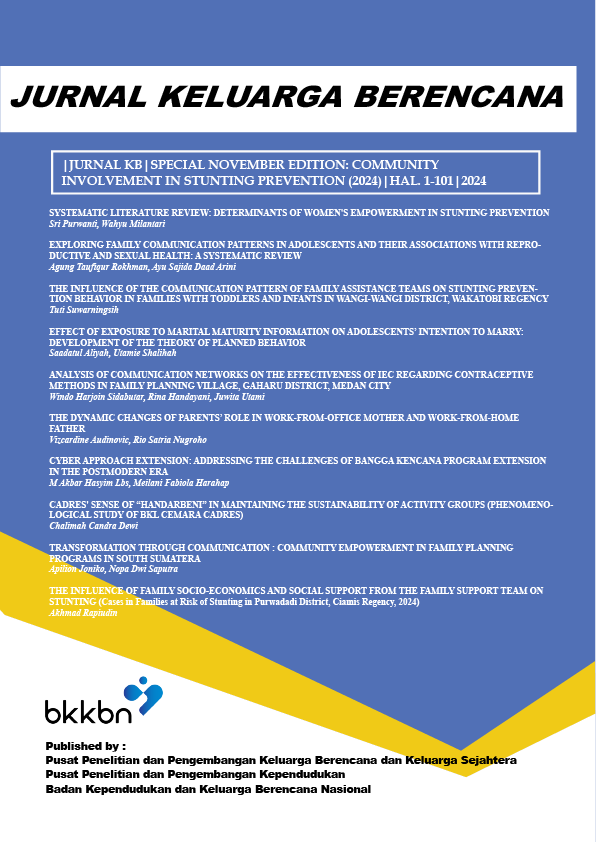
CADRES' SENSE OF “HANDARBENI” IN MAINTAINING THE SUSTAINABILITY OF ACTIVITY GROUPS (PHENOMENOLOGICAL STUDY OF BKL CEMARA CADRES)
DOI:
https://doi.org/10.37306/2t7dwc40Keywords:
Cadre, Elderly Family Development, HandarbeniAbstract
Among the challenges of Elderly Family Development (BKL) group activities is the issue of sustainability. Many groups are formed due to competition factors and stop activities afterwards. BKL Cemara Pondokrejo, Kapanewon Tempel Sleman Regency is able to maintain the sustainability of activities through the local wisdom of “handarbeni” or a sense of belonging. The purpose of this study was to obtain an in-depth description of cadres in building a sense of handarbeni so as to find ways to sustain the BKL group. This study used a qualitative approach with a descriptive phenomenological design. Through in-depth interviews, the data were analyzed using the Colaizzi technique to see the meaning of the role of cadres in managing BKL groups that underlie sustainability. The results of this study found that on the Back Stage, cadres experienced dynamics in maintaining group sustainability. The challenge of maintaining a sense of handarbeni is overcome from interpreting the role of cadres as a noble task to providing additional appreciation of financial benefits, recreation and periodic free health checks for administrators. In the Front Stage role, in their limitations, cadres try to appear cheerful, patient and polite in serving the elderly.
Downloads
References
Anggraini, Y. W., Priasmoro, D. P., & Aminah, T. (2022). Gambaran pengendalian emosi lansia dalam lingkungan padat penduduk Perum Gardenia Kabupaten Malang. Nursing Information Journal, 1(2), 42-47. https://doi.org/10.54832/nij.v1i2.211
[BKKBN] National Population and Family Planning Agency. (2023). Buku Pegangan Kader: Lansia Tangguh dengan Tujuh Dimensi. Direktorat Bina Ketahanan Keluarga Lansia dan Rentan. Badan Kependudukan dan Keluarga Berencana Nasional.
[BPS] Central Statistics Agency. (2023). Statistik Penduduk Lanjut Usia 2023. Jakarta: Badan Pusat Statistik.
Mulyana, D. (2018). Metodologi Penelitian Kualitatif, Paradigma Ilmu Komunikasi dan Ilmu Sosial Lainnya. Bandung: PT Remaja Rosdakarya.
Rosari, R. (2017). Hubungan kepemilikan psikologikal pada konteks budaya Jawa dengan anteseden dan konsekuensinya. Jurnal Siasat Bisnis, 20(1), 37–54. https://doi.org/10.20885/jsb.vol21.iss1.art3
Seftiani, S., Vibriyanti, D. (2020). Penyelenggaraan program Bina Keluarga Lansia (BKL) di wilayah perkotaan: potret permasalahan klasik. Jurnal Kependudukan Indonesia, 15, 59-7. DOI: 10.14203/jki.v15i1.533.
Sormin, E., Napitupulu, R., Andrianawati, N. S., Gunawan, R., Ernawati, R., & Wigunawati, E. (2019). Pendampingan pengelolaan dan pembinaan kelompok Bina Keluarga Lansia (BKL) melaui kegiatan pengabdian pada masyarakat dosen dan mahasiswa di wilayah Jakarta Timur. Jurnal Comunita Servizio, 1(2), 198-207. https://doi.org/10.33541/cs.v1i2.1289
Supeni, S., Saddhono, K. (2013). Cognitive behavior has replaced the javanese traditional values in global era. Asian Journal of Management Sciences and Education, 2(2), 156-162. http://www.ajmse.leena-luna.co.jp/AJMSEPDFs/Vol.2(2)/AJMSE2013(2.2-15).pdf
Suryani, AO. (2014). Leadership Styles in Indonesia: Between Cultural Specificity and Universality. Dissertation. Tilburg University. https://research.tilburguniversity.edu/files/3205046/Suryani_Leadership_19_05_2014.pdf
Wibowo, G., Soraya, I. (2023). Dramaturgi dalam membentuk persentasi diri presenter. Jurnal Komunikasi, 14(1), 59-72. https://doi.org/10.31294/jkom.v14i1.14650
Yuwono, S. (2015). Handarbeni dan Sense of Belonging di Universitas Muhammadiyah Surakarta. https://publikasiilmiah.ums.ac.id/xmlui/handle/11617/6501
Downloads
Published
Issue
Section
License
Copyright (c) 2024 Chalimah Candra Dewi

This work is licensed under a Creative Commons Attribution-NonCommercial-ShareAlike 4.0 International License.