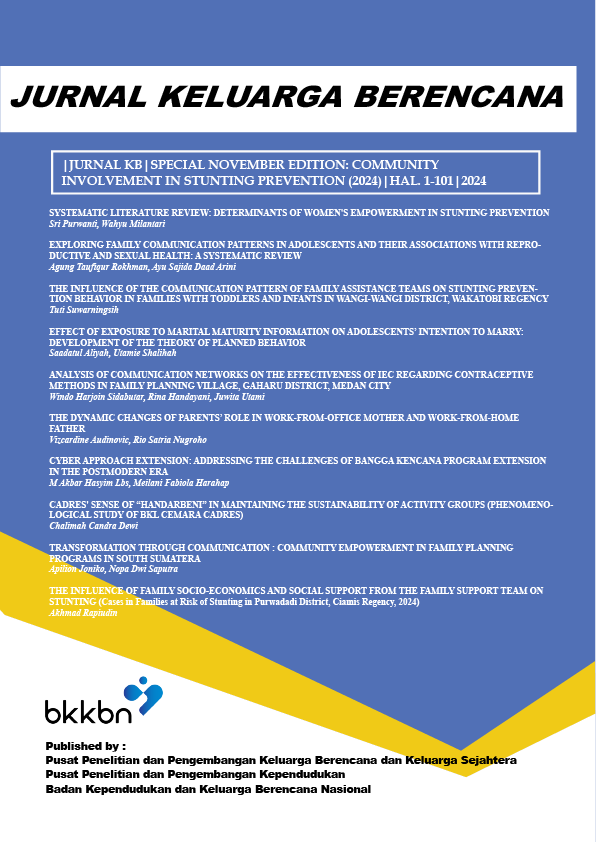
THE DYNAMIC CHANGES OF PARENTS’ ROLE IN WORK-FROM-OFFICE MOTHER AND WORK-FROM-HOME FATHER
DOI:
https://doi.org/10.37306/ynxyyv47Keywords:
Household, Parent role, Work from home, Work from officeAbstract
Currently, a man is more flexible in carrying out his role as a breadwinner either outside the home or from home. This research aims to further understand the factors underlying these changes and their implications for family dynamics, gender roles, and societal norms surrounding decision-making processes in modern families. This research explores the decision-making process in a dynamic family consisting of a mother who works in the office (work-from-office mother) and a father who works at home (work-from-home father). This research uses a phenomenological and qualitative approach to look at the phenomenon of the role of fathers who work at home and mothers who work in the office. Data collection was carried out through in-depth interviews with eligible couples. This research examines how gender roles influence decision making regarding family economic issues, children's education and family planning. These findings reveal important shifts in decision-making dynamics, with women taking more significant roles in these key areas. In particular, women show higher consideration and involvement in family economic decisions, children's educational choices, and family planning strategies. This shift highlights a shift away from traditional gender norms and underscores the evolving roles and responsibilities within contemporary family units.
Downloads
References
Adawiyah, N., & Rohmah, S. (2021). Gambaran peran suami dalam pemilihan alat kontrasepsi di PMB Bidan Elis Yanti S Kabupaten Tasikmalaya. Journal of Midwifery and Public Health, 3(1), 6. https://doi.org/10.25157/jmph.v3i1.6788
Afriliani, A. T. N., Adriany, V., & Yulindrasari, H. (2021). Peran ayah dalam pengasuhan: studi pada keluarga pekerja migran perempuan (PMP) di Kabupaten Sukabumi. Jurnal Ilmu Keluarga dan Konsumen, 14(2), 164–175. https://doi.org/10.24156/jikk.2021.14.2.164
Ashraf, F., & Jepsen, D. (2024). Private patriarchy’s impact on women’s careers: through kaleidoscope career model lens. Group & Organization Management. https://doi.org/10.1177/10596011241227263
Baralt, L., Carian, E. K., Johnson, A. L., Lim, S., & Yoon, S.-Y. (2020). Millennials and gender in an era of growing inequality. Sociological Perspectives, 63(3), 452–460. https://doi.org/10.1177/0731121420915870
Bergnehr, D. (2022). Adapted fathering for new times: refugee men’s narratives on caring for home and children. Journal of Family Studies, 28(3), 934–949. https://doi.org/10.1080/13229400.2020.1769708
Bramled, T. (1975). Educational reconstruction: Ripples, whirlpools, and hurricanes. Educational Studies, 6(4), 162–166. https://cmapsconverted.ihmc.us/rid=1H9QCV429-9BRR1T-H3X/Background.pdf
Chrisendo, D., Krishna, V. V., Siregar, H., & Qaim, M. (2020). Land-use change, nutrition, and gender roles in Indonesian farm households. Forest Policy and Economics, 118, 102245. https://doi.org/10.1016/j.forpol.2020.102245
Della, D., Pandia, W. S. S., & Saezarina, A. (2018). Gambaran konsep diri bapak rumah tangga. Jurnal Ilmiah Psikologi MANASA, 7(2), 72–81. https://ejournal.atmajaya.ac.id/index.php/Manasa/article/view/561
Few‐Demo, A. L., & Allen, K. R. (2020). Gender, feminist, and intersectional perspectives on families: a decade in review. Journal of Marriage and Family, 82(1), 326–345. https://doi.org/10.1111/jomf.12638
Herdiyanti, H. (2018). Role of career women in families: (study of the existence of career women in families in Balunijuk Village). Society, 6(1), 1–7. https://doi.org/10.33019/society.v6i1.59
Himawan, K. K., Helmi, J., & Fanggidae, J. (2021). Negotiating Indonesian married women’s agency in a career: work from home arrangement as a possible solution. The International Journal of Interdisciplinary Organizational Studies, 16(2), 15–22. https://doi.org/10.18848/2324-7649/CGP/v16i02/15-22
Himawan, K. K., Underwood, M., Bambling, M., & Edirippulige, S. (2022). Being single when marriage is the norm: Internet use and the well-being of never-married adults in Indonesia. Current Psychology, 41(12), 8850–8861. https://doi.org/10.1007/s12144-021-01367-6
Hudde, A., Hank, K., & Jacob, M. (2021). Gender role attitudes cannot explain how british couples responded to increased housework demands during the covid-19 pandemic. Socius: Sociological Research for a Dynamic World, 7, 237802312110643. https://doi.org/10.1177/23780231211064395
Ihsani, T., Wuryaningsih, C. E., & Sukarno. (2019). Peran pengambilan keputusan penggunaan MKJP di Indonesia (analisis lanjut data SRPJMN Tahun 2017). Jurnal Keluarga Berencana, 4(2), 12–13. https://doi.org/10.37306/kkb.v4i2.22
Kagan, M., & Lissitsa, S. (2023). Generations X, Y, Z: Attitudes toward social workers in the age of media technologies. Technology in Society, 75, 102353. https://doi.org/10.1016/j.techsoc.2023.102353
Lee, S. S., Chao M.M, & He, H. (2023). When family interrupted work: The implications of gendered role perception in the face of COVID‐19. Journal of Social Issues, 79(3), 861–877. https://doi.org/10.1111/josi.12504
Mukarromah, M., Kurniawati, D. A., & Jannah, S. (2023). Peran istri berpendidikan lebih tinggi dari suami terhadap keharmonisan keluarga dalam perspektif hukum islam (studi kasus di Desa Batokaban Kecamatan Konang Kabupaten Bangkalan). Jurnal Hikmatina, 5(2), 85–95. https://jim.unisma.ac.id/index.php/jh/article/view/20984
Neuman, W. L. (2014). Social Research Methods: Qualitative and Quantitative Approaches, 7th Ed. London: Pearson Education Limited.
Nuryana, A., Pawito, P., & Utari, P. (2019). Pengantar metode penelitian kepada suatu pengertian yang mendalam mengenai konsep fenomenologi. ENSAINS JOURNAL, 2(1), 19. https://doi.org/10.31848/ensains.v2i1.148
Orozco Collazos, L. E., & Baldrich Mora, V. A. (2020). Gender, violence and social resources in rural producers’ economic decisions. Journal of Rural Studies, 80, 222–234. https://doi.org/10.1016/j.jrurstud.2020.09.011
Pancawati, G., Priyono, B., & Rahmawati, A. (2021). how gender shapes family resilience in millennials. The Indonesian Journal of Public Administration (IJPA), 7(1), 76–94. https://doi.org/10.52447/ijpa.v7i1.4651
Pramanada, N. A., & Dinardinata, A. (2020). Pengalaman suami menjadi stay-at-home dad pada usia dewasa awal. Jurnal Empati, 7(2), 735–744. https://doi.org/10.14710/empati.2018.21706
Pratisiya, V., Pantes, A., Fahira, S., Musa, D. T., Alamri, A. R., & Mutmainnah, M. (2023). Perubahan konstruksi sosial dalam pembagian kerja domestik: Studi hubungan antara suami istri keluarga modern. Yinyang: Jurnal Studi Islam Gender dan Anak, 18(2), 197–222. https://doi.org/10.24090/yinyang.v18i2.8573
Rizkillah, R., Sunarti, E., & Herawati, T. (2015). Kualitas perkawinan dan lingkungan pengasuhan pada keluarga dengan suami istri bekerja. Jurnal Ilmu Keluarga dan Konsumen, 8(1), 10–19. https://doi.org/10.24156/jikk.2015.8.1.10
Rua, T., Aytug, Z., Simarasl, N., & Lin, L. (2020). How traditional gender roles hurt both women and men: negative processes and outcomes in mixed-gender negotiations. Gender in Management, 36(2), 271–293. https://doi.org/10.1108/GM-05-2019-0065
Ruspini, E. (2019). Millennial men, gender equality and care: the dawn of a revolution? Teorija in Praksa, 56(4), 985–1000. https://www.fdv.uni-lj.si/docs/default-source/tip/milenijci-enakost-spolov-in-skrbstveno-delo-znamenja-revolucije.pdf?sfvrsn=0
Salazar, R. A., & Acido-Muega, M. (2020). Social reconstruction as collaborative efforts of social units to address social ills and problems in the Philippines in time of the COVID-19 pandemic. Running Head: SOCIAL RECONSTRUCTION AS COLLABORATIVE EFFORTS, 1–23. https://www.researchgate.net/publication/342623933_Running_Head_SOCIAL_RECONSTRUCTION_AS_COLLABORATIVE_EFFORTS_--_Social_Reconstruction_as_Collaborative_Efforts_of_Social_Units_to_Address_Social_Ills_and_Problems_in_the_Philippines_in_Time_of_the_COVI
Shaleh, A. R., & Nuraini, P. (2021). Examining gender role attitude as a moderator of personality, social support, and childcare responsibilities in women’s work-life balance. Psikohumaniora: Jurnal Penelitian Psikologi, 6(2), 229–244. https://doi.org/10.21580/pjpp.v6i2.9591
Sugitanata, A., & Zakariya, Moh. (2021). peralihan peran pasangan terdidik antara suami dan istri. Mahkamah: Jurnal Kajian Hukum Islam, 6(2), 239. https://doi.org/10.24235/mahkamah.v6i2.7961
Sulaiman, A. (2016). Memahami teori konstruksi sosial Peter L. Berger. Society, 4(1), 15–22. https://doi.org/10.33019/society.v4i1.32
Wulan, T. R., Shodiq, D., Wijayanti, S., Lestari, D. W. D., Hapsari, A. T., Wahyuningsih, E., & Restuadhi, H. (2018). Ayah tangguh, keluarga utuh : pola asuh ayah pada keluarga buruh migran perempuan di Kabupaten Banyumas. Jurnal Ilmu Keluarga dan Konsumen, 11(2), 84–95. https://doi.org/10.24156/jikk.2018.11.2.84
Yuniati, E., Mulya, T. W., & Nanik, N. (2023). Traditional to egalitarian: A literature review of fatherhood from the gender role perspective. The 1stInternational Conference on Indigenous Psychology & Culture (ICIPC) 2023, 27–37. https://seminar.ustjogja.ac.id/index.php/icipc/article/view/689
Zuhri, S., & Amalia, D. (2022). Ketidakadilan gender dan budaya patriarki di kehidupan masyarakat Indonesia. Murabbi: Jurnal Ilmiah dalam Bidang Pendidikan, 5(1).
Downloads
Published
Issue
Section
License
Copyright (c) 2024 Vizcardine Audinovic, Rio Satria Nugroho

This work is licensed under a Creative Commons Attribution-NonCommercial-ShareAlike 4.0 International License.