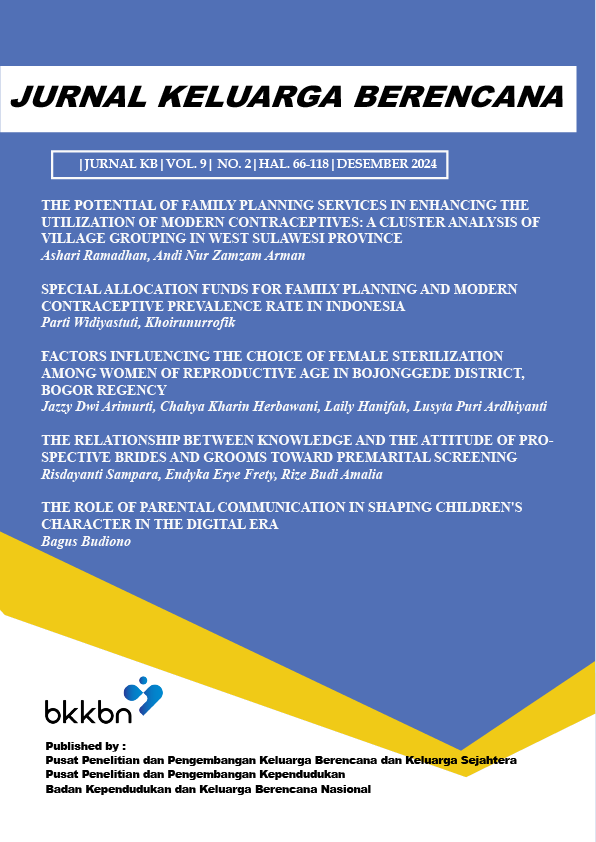
THE ROLE OF PARENTAL COMMUNICATION IN SHAPING CHILDREN'S CHARACTER IN THE DIGITAL ERA
DOI:
https://doi.org/10.37306/98vpvr88Keywords:
parental communication, digital character, digital parenting, media literacy, digital resilienceAbstract
The rapid development of digital technology has brought both opportunities and challenges for parents in shaping their children's character. This study aims to analyze the effectiveness of parental communication strategies in shaping children's digital behavior and character development amid increasing online risks and influences. The study uses a qualitative approach with a phenomenological design to explore parents' lived experiences in communicating with their children to foster positive character development in the digital era. Purposive sampling was employed to select six parents (three mothers and three fathers) with children aged 10-15 years who actively use digital devices. Data were collected through in-depth semi-structured interviews, and a thematic analysis was used to identify key communication strategies, challenges, and parental roles in shaping digital behavior. The results showed that parents adopted various effective communication practices, specifically maintaining open dialogue through regular family discussions, implementing collaborative rule-setting, engaging in active mentoring through shared digital activities, and modeling appropriate technology use behavior. The main challenges included gaps in technological knowledge and limited quality time. Parents played roles as digital educators, supervisors, and role models. Effective communication had a positive impact on children's awareness of online risks and responsible use of technology. However, consistent implementation of rules and peer influence remain challenges. The study highlights the importance of adaptive and supportive communication practices while also addressing technological knowledge gaps and peer influences.
Downloads
References
Baumrind, D. (2019). Parenting styles and character development. Journal of Early Adolescence, 39(5), 633-655. https://doi.org/10.1177/0272431618771607
Beyens, I., Valkenburg, P. M., & Piotrowski, J. T. (2020). Developmental trajectories of parental mediation across early and middle childhood. Human Communication Research, 46(2-3), 173-198. https://doi.org/10.1093/hcr/hqz016
Bjelland, M., Soenens, B., Bae, D., Bekalu, M., & Canale, N. (2021). Parental mediation of children's digital technology use: A systematic review. New Media & Society, 23(5), 1119-1141. https://doi.org/10.1177/1461444820902541
Braun, V., & Clarke, V. (2022). Thematic analysis: A practical guide. SAGE Publications Ltd.
Chen, L., Shi, J., & Guo, Y. (2021). Digital technology use and children's emotional intelligence: The mediating role of parent-child communication. Computers in Human Behavior, 120, 106753. https://doi.org/10.1016/j.chb.2021.106753
Coyne, S. M., et al. (2023). Parenting and digital media. Pediatrics, 151(Supplement 2), e2022057700I.
Creswell, J. W., & Poth, C. N. (2018). Qualitative inquiry and research design: Choosing among five approaches (4th ed.). SAGE Publications, Inc.
Granic, I., Morita, H., & Scholten, H. (2020). Beyond screen time: Identity development in the digital age. Psychological Inquiry, 31(3), 195-223. https://doi.org/10.1080/1047840X.2020.1820214
Jones, L. M., & Mitchell, K. J. (2021). Defining and measuring youth digital citizenship. New Media & Society, 23(5), 1017-1037. https://doi.org/10.1177/1461444820902748
Joussemet, M., et al. (2023). Promoting optimal parenting and children's mental health: A preliminary evaluation of the how-to parenting program. Journal of Child and Family Studies, 32(1), 149-166. https://doi.org/10.1007/s10826-013-9751-0
Joussemet, M., Mageau, G. A., & Koestner, R. (2023). Promoting optimal parenting and children's mental health: A preliminary evaluation of the how-to parenting program. Journal of Child and Family Studies, 32(1), 149-166. https://doi.org/10.1007/s10826-022-02482-z
Kerr, M., Stattin, H., & Özdemir, M. (2022). Perceived parenting style and adolescent adjustment: Revisiting directions of effects and the role of parental knowledge. Developmental Psychology, 58(2), 228-240. https://doi.org/10.1037/dev0001310
Lickona, T., & Davidson, M. (2021). Character education: A proven approach to cultivating ethical and successful students. Journal of Character Education, 17(1), 1-18.Lincoln, Y. S., & Guba, E. G. (1985). Naturalistic inquiry. SAGE Publications, Inc.
Livingstone, S., & Blum-Ross, A. (2020). Parenting for a digital future: How hopes and fears about technology shape children's lives. Oxford University Press.
Livingstone, S., & Stoilova, M. (2021). The 4Cs: Classifying online risk to children. (CO:RE Short Report Series on Key Topics). Hamburg: Leibniz-Institut für Medienforschung
Livingstone, S., Mascheroni, G., & Staksrud, E. (2019). European research on children's internet use: Assessing the past and anticipating the future. New Media & Society, 21(1), 135-154. https://doi.org/10.1177/1461444818815951
Mascheroni, G., et al. (2020). Digital parenting: The challenges for families in the digital age. Nordicom, University of Gothenburg.
Mascheroni, G., Livingstone, S., & Staksrud, E. (2022). Digital parenting: The challenges for families in the digital age. Nordicom.
Padilla-Walker, L. M., et al. (2020). The protective role of parental media monitoring style from early to late adolescence. Journal of Youth and Adolescence, 49(4), 916-930. doi: 10.1007/s10964-017-0722-4.
Pantic, I., Milanovic, A., Loboda, B., Błachnio, A., Przepiorka, A., Nesic, D., Mazic, S., Dugalic, S., & Ristic, S. (2022). Excessive screen time and psychophysiological stress recovery: A narrative review. International Journal of Environmental Research and Public Health, 19(3), 1270. https://doi.org/10.3390/ijerph19031270
Park, Y., & Kim, S. (2023). The role of parental mediation in cyberbullying perpetration and victimization among children. Computers in Human Behavior, 138, 107393. https://doi.org/10.1016/j.chb.2022.107393
Patton, M. Q. (2020). Qualitative research & evaluation methods: Integrating theory and practice (4th ed.). SAGE Publications, Inc.
Prensky, M. (2019). Digital natives, digital immigrants. On the Horizon, 9(5), 1-6.
Przybylski, A. K., & Weinstein, N. (2019). Digital screen time limits and young children's psychological well-being: Evidence from a population-based study. Child Development, 90(1), e56-e65. https://doi.org/10.1111/cdev.13007
Rahmat, N. H., Effendi, M., & Priatna, T. (2022). Parental mediation on children's digital media use: A study in Indonesia. Jurnal Pendidikan Islam, 8(1), 79-94. https://doi.org/10.15575/jpi.v8i1.13771
Rodríguez-de-Dios, I., Oosten, J. M. F., & Igartua, J. J. (2023). A longitudinal study of parental mediation of technology use and children's self-regulation. New Media & Society, 25(3), 700-720. https://doi.org/10.1177/1461444821993531
Twenge, J. M., & Campbell, W. K. (2022). Associations between screen time and lower psychological well-being among children and adolescents: Evidence from a population-based study. Preventive Medicine Reports, 18, 101218. https://doi.org/10.1016/j.pmedr.2020.101218
Valkenburg, P. M., et al. (2023). Social media use and adolescents' self-esteem: Heading for a person-specific media effects paradigm. Journal of Communication, 71(1), 56-78. https://doi.org/10.1093/joc/jqaa039
Wartella, E., et al. (2020). Parenting in the age of digital technology: How families use media and technology in their daily lives. Center on Media and Human Development, School of Communication, Northwestern University.
Waters, L., et al. (2021). Observing change over time in strength-based parenting and subjective well-being for pre-teens and teens. Frontiers in Psychology, 12, 708536. doi: 10.3389/fpsyg.2019.02273.
Downloads
Published
Issue
Section
License
Copyright (c) 2024 Bagus Budiono

This work is licensed under a Creative Commons Attribution-NonCommercial-ShareAlike 4.0 International License.